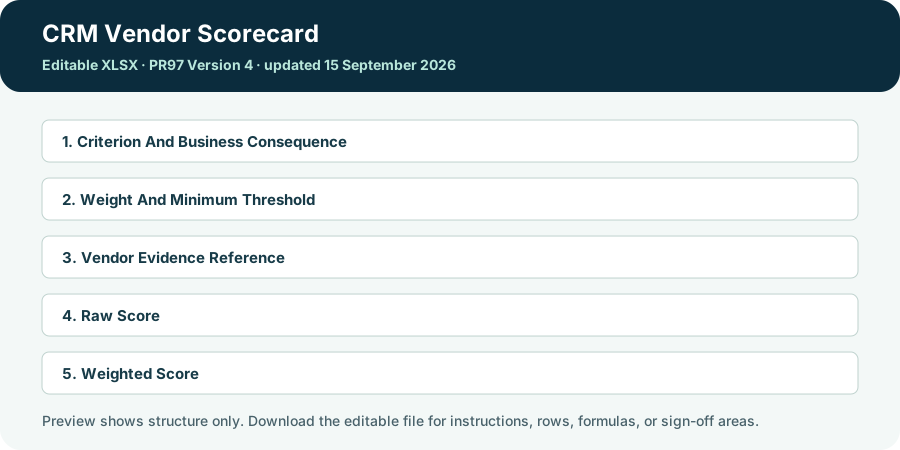
This file helps a buyer score CRM finalists against weighted, testable workflows and minimum gates. It does not make the decision automatically; named reviewers must attach evidence, resolve mandatory gaps, and sign the final record.
For CRM Vendor Scorecard, the practical checkpoint is specific: 1 worksheet(s): Working File; working range up to 24 rows by 9 columns; 40 formula cells; 4 data-validation rule(s). File size: 5,415 bytes. Counts describe the packaged file and are not marketing estimates.
What is inside the download
| # | Working area | Completion standard |
|---|---|---|
| 1 | Criterion And Business Consequence | Write an observable business result with actor, context, exception, volume, output, and pass threshold. |
| 2 | Weight And Minimum Threshold | Record the specific fact, its dated source, accountable owner, current status, and consequence if it remains unresolved. |
| 3 | Vendor Evidence Reference | Link or identify the dated artifact, scope, owner, reviewer, and any gap that prevents it from supporting the decision. |
| 4 | Raw Score | Use a defined scale or status, cite the evidence, record dissent or conditions, and assign the next action and date. |
| 5 | Weighted Score | Use a defined scale or status, cite the evidence, record dissent or conditions, and assign the next action and date. |
| 6 | Risk, Assumption, And Decision Note | Describe the event, business consequence, likelihood, trigger, mitigation, accountable owner, and closure evidence. |
Worked example
Pipeline reporting is weighted at 15%, but permission isolation is a mandatory gate. A vendor can achieve the highest weighted score and still fail if the trial cannot prevent one regional team from seeing another team's restricted records.
In the CRM Vendor Scorecard decision, this evidence rule applies: the example shows the level of specificity expected; replace it with the buyer's own users, volumes, dates, evidence, commercial terms, and acceptance authority. Do not copy an example into an approval record as if it were observed evidence.
Review timing
Freeze the criteria before final demos, then update only with cited demo, trial, security, reference, or contract evidence.
CRM scoring decisions that need special care
Separate revenue-process evidence from general usability. Use actual territory, pipeline, forecast, duplicate, handoff, permission, integration, and export scenarios. A seller liking the interface cannot compensate for an unreliable forecast definition or a permission failure. Document the exact edition, configured fields, automation, sample records, and administrator work behind every score.
Before consensus, compare evaluator variance. A large difference between sales operations, frontline users, IT, and security is evidence that the criterion or demonstration was ambiguous. Re-run the scenario or narrow the acceptance rule instead of negotiating an average in the meeting. Retain failed steps and accepted workarounds in the final CRM recommendation.
Failure modes this template is designed to expose
- Letting vendors choose the demo script
- Giving every criterion equal weight
- Scoring roadmap promises as delivered capability
- Averaging away a failed mandatory control
Completion sequence for this file
- Set the boundary: agree Criterion And Business Consequence and Weight And Minimum Threshold before collecting detailed answers.
- Reconcile the record: test Vendor Evidence Reference against Raw Score; preserve the source and explain conflicts.
- Close or escalate: use Weighted Score and Risk, Assumption, And Decision Note to record the final action, authority, evidence, and next review.
Field-level Decision comments for this file
In the CRM Vendor Scorecard decision, this evidence rule applies: the six working areas below are connected. Reviewers should reconcile them rather than complete each cell in isolation.
Criterion And Business Consequence
Begin this check with Criterion And Business Consequence. For the CRM Vendor Scorecard, reliable support normally includes an actor, realistic starting data, action, exception, volume, output, and observable pass threshold. Cross-check the result against Weight And Minimum Threshold, because a mismatch can change whether the file supports the decision to score CRM finalists against weighted, testable workflows and minimum gates. Return the entry to its owner when it relies on a feature name or adjective that lets every vendor claim support without completing the buyer's work. A reviewer should be able to reproduce the conclusion without attending the original meeting.
Weight And Minimum Threshold
The next control point is Weight And Minimum Threshold. For the CRM Vendor Scorecard, reliable support normally includes a dated primary record, accountable owner, review status, business consequence, and the proof required for closure. Cross-check the result against Vendor Evidence Reference, because a mismatch can change whether the file supports the decision to score CRM finalists against weighted, testable workflows and minimum gates. Return the entry to its owner when it relies on an unlabeled assumption, copied answer, or blank cell that another reviewer might mistake for confirmation. If the source changes, update the entry and state whether the decision changes with it.
Vendor Evidence Reference
Treat as decision evidence Vendor Evidence Reference. For the CRM Vendor Scorecard, reliable support normally includes the actual dated artifact, its scope and period, the reviewer, and a link in an approved evidence repository. Cross-check the result against Raw Score, because a mismatch can change whether the file supports the decision to score CRM finalists against weighted, testable workflows and minimum gates. Return the entry to its owner when it relies on recording a document title without checking boundaries, exceptions, expiry, or whether it covers the purchased service. Where proof is incomplete, preserve a conservative assumption and a dated closure action.
Raw Score
Before sign-off, challenge Raw Score. For the CRM Vendor Scorecard, reliable support normally includes a defined scale, dated supporting evidence, reviewer identity, dissent or condition, next action, and approval authority. Cross-check the result against Weighted Score, because a mismatch can change whether the file supports the decision to score CRM finalists against weighted, testable workflows and minimum gates. Return the entry to its owner when it relies on an average score or completed status that hides a failed mandatory gate or an unresolved dependency. Any accepted limitation needs a named authority, business consequence, and next review date.
Weighted Score
Use an independent review of Weighted Score. For the CRM Vendor Scorecard, reliable support normally includes a defined scale, dated supporting evidence, reviewer identity, dissent or condition, next action, and approval authority. Cross-check the result against Risk, Assumption, And Decision Note, because a mismatch can change whether the file supports the decision to score CRM finalists against weighted, testable workflows and minimum gates. Return the entry to its owner when it relies on an average score or completed status that hides a failed mandatory gate or an unresolved dependency. The completed entry should survive renewal, incident, audit, or replacement review.
Risk, Assumption, And Decision Note
Close the record only after reviewing Risk, Assumption, And Decision Note. For the CRM Vendor Scorecard, reliable support normally includes a specific event, likelihood, business consequence, trigger, mitigation, decision authority, and closure proof. Cross-check the result against Criterion And Business Consequence, because a mismatch can change whether the file supports the decision to score CRM finalists against weighted, testable workflows and minimum gates. Return the entry to its owner when it relies on using a vague red-amber-green label that has no trigger, owner, due date, or consequence. Do not mark this area complete until its contradiction with the connected field is resolved.
Approval questions specific to the CRM Vendor Scorecard
- Criterion And Business Consequence: What would independently confirm this entry, and what happens to the decision if the only available support is a feature name or adjective that lets every vendor claim support without completing the buyer's work?
- Weight And Minimum Threshold: What would independently confirm this entry, and what happens to the decision if the only available support is an unlabeled assumption, copied answer, or blank cell that another reviewer might mistake for confirmation?
- Vendor Evidence Reference: What would independently confirm this entry, and what happens to the decision if the only available support is recording a document title without checking boundaries, exceptions, expiry, or whether it covers the purchased service?
- Raw Score: What would independently confirm this entry, and what happens to the decision if the only available support is an average score or completed status that hides a failed mandatory gate or an unresolved dependency?
- Weighted Score: What would independently confirm this entry, and what happens to the decision if the only available support is an average score or completed status that hides a failed mandatory gate or an unresolved dependency?
Final challenge: Could sales operations, revenue leadership, IT, security, procurement, and frontline evaluators explain the decision, reproduce its key calculation or control, and identify the next action from this file alone? If not, the record is not ready for approval.