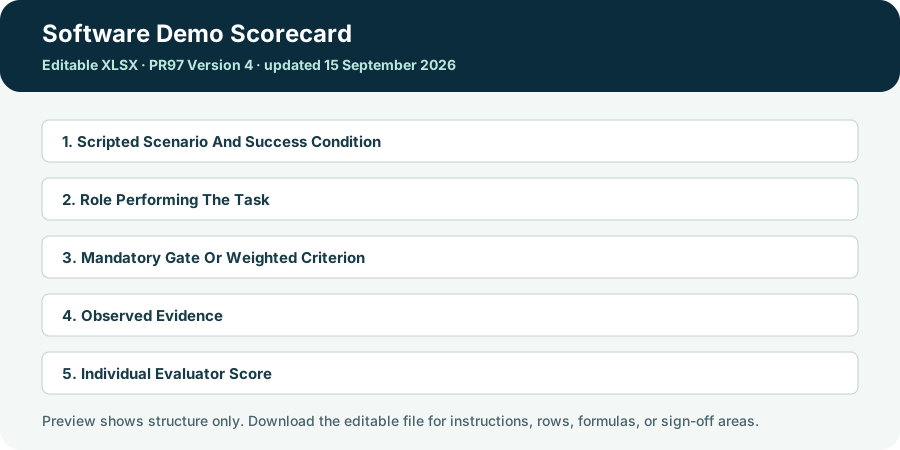
This file helps a buyer capture comparable evidence from scripted vendor demonstrations before enthusiasm replaces evaluation. It does not make the decision automatically; named reviewers must attach evidence, resolve mandatory gaps, and sign the final record.
For Software Demo Scorecard, this requirement applies: 1 worksheet(s): Working File; working range up to 24 rows by 9 columns; 40 formula cells; 4 data-validation rule(s). File size: 5,380 bytes. Counts describe the packaged file and are not marketing estimates.
What is inside the download
| # | Working area | Completion standard |
|---|---|---|
| 1 | Scripted Scenario And Success Condition | Write an observable business result with actor, context, exception, volume, output, and pass threshold. |
| 2 | Role Performing The Task | Name an accountable person or role, define the decision or action they own, and state how completion will be confirmed. |
| 3 | Mandatory Gate Or Weighted Criterion | Write an observable business result with actor, context, exception, volume, output, and pass threshold. |
| 4 | Observed Evidence | Link or identify the dated artifact, scope, owner, reviewer, and any gap that prevents it from supporting the decision. |
| 5 | Individual Evaluator Score | Use a defined scale or status, cite the evidence, record dissent or conditions, and assign the next action and date. |
| 6 | Consensus Score, Issue, And Follow-Up | Describe the event, business consequence, likelihood, trigger, mitigation, accountable owner, and closure evidence. |
Worked example
Each vendor must create a customer record, route an exception, correct an error, and export the audit evidence using the same scenario. Evaluators score observed behavior independently before a consensus discussion, and unanswered steps become follow-ups rather than assumed passes.
For this Software Demo Scorecard review, use this evidence rule: the example shows the level of specificity expected; replace it with the buyer's own users, volumes, dates, evidence, commercial terms, and acceptance authority. Do not copy an example into an approval record as if it were observed evidence.
Review timing
Prepare it before invitations are sent and lock scores immediately after each demonstration.
Keep the demonstration controlled
Send vendors the business scenario and success condition, but do not replace difficult exceptions with a vendor-selected tour. Use the same starting data, roles, time box, and follow-up deadline for every finalist. Record when the presenter changes configuration, switches editions, uses a hidden administrator privilege, or promises that support will complete the task later.
Collect individual scores before discussion to prevent the most enthusiastic attendee from setting the room's answer. A consensus score must cite the observed step and explain any change from the individual results. Open questions remain open; presentation confidence is not evidence that an unseen workflow, export, or control works.
Failure modes this template is designed to expose
- Scoring presentation polish instead of task completion
- Changing scenarios between vendors
- Allowing group discussion before individual scoring
- Leaving screenshots and follow-up answers unattached
Completion sequence for this file
- Set the boundary: agree Scripted Scenario And Success Condition and Role Performing The Task before collecting detailed answers.
- Reconcile the record: test Mandatory Gate Or Weighted Criterion against Observed Evidence; preserve the source and explain conflicts.
- Close or escalate: use Individual Evaluator Score and Consensus Score, Issue, And Follow-Up to record the final action, authority, evidence, and next review.
Field-level Decision comments for this file
For this Software Demo Scorecard review, use this evidence rule: the six working areas below are connected. Reviewers should reconcile them rather than complete each cell in isolation.
Scripted Scenario And Success Condition
Begin this check with Scripted Scenario And Success Condition. For the Software Demo Scorecard, reliable support normally includes an actor, realistic starting data, action, exception, volume, output, and observable pass threshold. Cross-check the result against Role Performing The Task, because a mismatch can change whether the file supports the decision to capture comparable evidence from scripted vendor demonstrations before enthusiasm replaces evaluation. Return the entry to its owner when it relies on a feature name or adjective that lets every vendor claim support without completing the buyer's work. A reviewer should be able to reproduce the conclusion without attending the original meeting.
Role Performing The Task
The next control point is Role Performing The Task. For the Software Demo Scorecard, reliable support normally includes a named accountable role, its authority, the population in scope, and the record that confirms action. Cross-check the result against Mandatory Gate Or Weighted Criterion, because a mismatch can change whether the file supports the decision to capture comparable evidence from scripted vendor demonstrations before enthusiasm replaces evaluation. Return the entry to its owner when it relies on assigning a department instead of a person or omitting guests, contractors, privileged users, and shared accounts. If the source changes, update the entry and state whether the decision changes with it.
Mandatory Gate Or Weighted Criterion
Treat as decision evidence Mandatory Gate Or Weighted Criterion. For the Software Demo Scorecard, reliable support normally includes an actor, realistic starting data, action, exception, volume, output, and observable pass threshold. Cross-check the result against Observed Evidence, because a mismatch can change whether the file supports the decision to capture comparable evidence from scripted vendor demonstrations before enthusiasm replaces evaluation. Return the entry to its owner when it relies on a feature name or adjective that lets every vendor claim support without completing the buyer's work. Where proof is incomplete, preserve a conservative assumption and a dated closure action.
Observed Evidence
Before sign-off, challenge Observed Evidence. For the Software Demo Scorecard, reliable support normally includes the actual dated artifact, its scope and period, the reviewer, and a link in an approved evidence repository. Cross-check the result against Individual Evaluator Score, because a mismatch can change whether the file supports the decision to capture comparable evidence from scripted vendor demonstrations before enthusiasm replaces evaluation. Return the entry to its owner when it relies on recording a document title without checking boundaries, exceptions, expiry, or whether it covers the purchased service. Any accepted limitation needs a named authority, business consequence, and next review date.
Individual Evaluator Score
Use an independent review of Individual Evaluator Score. For the Software Demo Scorecard, reliable support normally includes a defined scale, dated supporting evidence, reviewer identity, dissent or condition, next action, and approval authority. Cross-check the result against Consensus Score, Issue, And Follow-Up, because a mismatch can change whether the file supports the decision to capture comparable evidence from scripted vendor demonstrations before enthusiasm replaces evaluation. Return the entry to its owner when it relies on an average score or completed status that hides a failed mandatory gate or an unresolved dependency. The completed entry should survive renewal, incident, audit, or replacement review.
Consensus Score, Issue, And Follow-Up
Close the record only after reviewing Consensus Score, Issue, And Follow-Up. For the Software Demo Scorecard, reliable support normally includes a specific event, likelihood, business consequence, trigger, mitigation, decision authority, and closure proof. Cross-check the result against Scripted Scenario And Success Condition, because a mismatch can change whether the file supports the decision to capture comparable evidence from scripted vendor demonstrations before enthusiasm replaces evaluation. Return the entry to its owner when it relies on using a vague red-amber-green label that has no trigger, owner, due date, or consequence. Do not mark this area complete until its contradiction with the connected field is resolved.
Approval questions specific to the Software Demo Scorecard
- Scripted Scenario And Success Condition: What would independently confirm this entry, and what happens to the decision if the only available support is a feature name or adjective that lets every vendor claim support without completing the buyer's work?
- Role Performing The Task: What would independently confirm this entry, and what happens to the decision if the only available support is assigning a department instead of a person or omitting guests, contractors, privileged users, and shared accounts?
- Mandatory Gate Or Weighted Criterion: What would independently confirm this entry, and what happens to the decision if the only available support is a feature name or adjective that lets every vendor claim support without completing the buyer's work?
- Observed Evidence: What would independently confirm this entry, and what happens to the decision if the only available support is recording a document title without checking boundaries, exceptions, expiry, or whether it covers the purchased service?
- Individual Evaluator Score: What would independently confirm this entry, and what happens to the decision if the only available support is an average score or completed status that hides a failed mandatory gate or an unresolved dependency?
Final challenge: Could evaluation teams running finalist demos for operational, technical, and commercial stakeholders explain the decision, reproduce its key calculation or control, and identify the next action from this file alone? If not, the record is not ready for approval.