SaaS Pricing & Procurement Lab

Turn software quotes into buyer-verifiable decisions

Free, editable procurement files and constraint-based guides for pricing, total cost, demonstrations, approvals, renewals, and vendor exit.

No registrationEditable XLSX and DOCXNo vendor ratings for sale
The PR97 buying loop
  1. Define constraints
  2. Collect comparable evidence
  3. Normalize cost
  4. Approve with owners
  5. Prepare renewal and exit

What the Procurement Lab does

The PR97 SaaS Pricing & Procurement Lab is a working area for buyers who need more than a list of plan names. It connects current vendor-published information with editable files that help a team define quantities, expose cost drivers, compare configurations, capture evidence, assign owners, and preserve the final decision. The Lab is designed for small and midsize organizations as well as individual procurement, finance, IT, security, operations, and business leaders who need a repeatable buying process.

The Lab does not publish invented review scores, guaranteed savings, or a universal “best” product. Software fit depends on workflow, data, roles, scale, controls, delivery capacity, contract terms, and the alternatives already in place. Every guide therefore begins with procurement constraints. The tools leave room for the actual quote, contract, test, and approval evidence because those documents control the real purchase.

The five-part SaaS buying model

01

Frame

Define the business outcome, current baseline, users, workflow, volume, data, controls, timetable, and decision owner.

02

Test

Run identical demonstrations or trials with representative roles, sample data, success conditions, and recorded evidence.

03

Cost

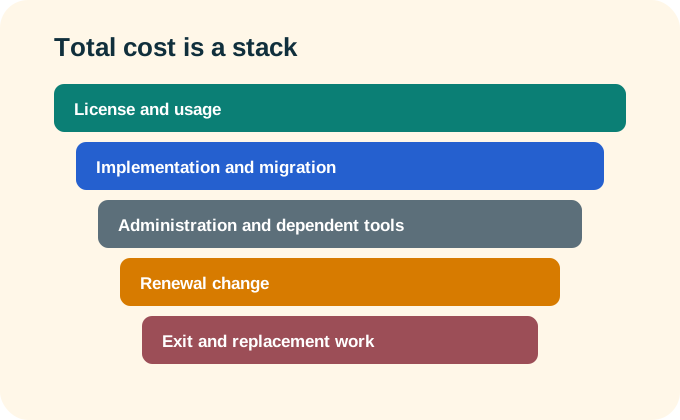
Normalize licenses, usage, services, internal work, dependencies, renewal change, and exit across three scenarios.

04

Approve

Resolve mandatory gates, document exceptions, name operating owners, and keep the accepted commercial documents.

05

Control

Track adoption, seats, incidents, contract notice, renewal decisions, export readiness, and eventual vendor exit.

Start with the constraint, not the generic keyword

A generic search such as “Slack pricing” or “best CRM” often leads to a page that cannot answer the buyer's real question. A procurement constraint creates a better brief: Slack pricing for external guests and retention; CRM selection for mixed sales and service roles; help desk cost under seasonal AI-assisted demand; or productivity-suite migration with archived users and compliance controls. These statements identify the quantities, edition boundaries, evidence tests, implementation work, and contract questions that can change the decision.

Write one sentence that combines the product or category, the operating situation, and the hardest constraint. Then use the files below to convert that sentence into a controlled evaluation. This approach also makes vendor conversations more efficient because the buyer can ask for a configuration and quote tied to a known scenario.

Core pricing and approval files

How to normalize a SaaS quote

  1. Identify the billable unit. Separate employees, full users, limited users, guests, senders, agents, hosts, devices, workspaces, transactions, storage, credits, and any product-specific unit.
  2. Define quantities over time. Record current, launch, expected, peak, and renewal quantities. Include seasonality, growth, contractors, service accounts, inactive identities, and workload variability where relevant.
  3. Map edition and add-on boundaries. Tie every mandatory capability to the plan, product, allowance, or service that supplies it. Mark dependencies and premium products visibly.
  4. Add delivery and operation. Include vendor services, implementation partners, migration, integration, internal labor, administration, support, training, data work, and retained duplicate tools.
  5. Read the commercial mechanics. Confirm term, billing, minimums, true-up, overage, reassignment, reduction, renewal notice, price change, export, transition, and termination.
  6. Calculate a range. Use base, expected, and stress cases. Unknown inputs remain visible and receive an owner rather than being entered as zero.

Evidence standard

A procurement statement should be traceable to one of four evidence types: a current official vendor source, a written vendor response, a controlled demonstration or trial result, or an accepted contract document. Internal estimates are also necessary, but label them as assumptions and show their source. A vendor logo, marketplace listing, sales slide, copied review score, or undated summary is not sufficient evidence for a material cost or control claim.

Each completed tool should include the reviewer or contributor responsible for the relevant subject, the date, the evidence location, the status, and the decision consequence. Restricted reports and contracts should stay in approved storage; the workbook or document can link to that location and record a concise conclusion. PR97 pages link to official public sources, but the documents issued for the actual transaction should govern the final decision.

Featured constraint-based pricing guides

Featured decision comparisons

The comparison pages below use a shared method but different evidence tests. They do not declare a universal winner. Use them to create a shortlist, then confirm the proposed editions and configurations with both vendors.

Editorial boundary

PR97 is an independent procurement-information site. Vendor links are used as sources, not as proof that PR97 endorses a product. Advertising can appear on the site, but it does not buy a ranking or favorable conclusion. The author is named on upgraded pages. A separate reviewer is named only when that person has actually completed and accepted a review; PR97 does not invent reviewer identities or credentials.

Frequently asked questions

Are the downloads really editable?

Yes. The library contains actual XLSX workbooks and DOCX documents. Spreadsheet files include structured tables, formulas where a calculation is useful, status fields, instructions, and review areas. Document files include editable prompts, checklists, response sections, and signoff areas.

Do I need to submit an email address?

No. The files can be downloaded directly. PR97 does not require registration for the Procurement Lab downloads.

Can the files replace professional advice?

No. They organize questions and evidence. Legal, tax, accounting, security, privacy, technical, and regulatory conclusions should be made by qualified people who understand the organization and transaction.

How often should a pricing model be updated?

Update it whenever quantities, scope, edition, add-ons, implementation, contract terms, or the vendor quote changes. Rebuild the model early enough to act before the renewal notice deadline.