This file helps a buyer normalize unlike SaaS quotes into one three-year cost view before commercial approval. It does not make the decision automatically; named reviewers must attach evidence, resolve mandatory gaps, and sign the final record.
For SaaS Pricing Comparison Worksheet, the practical checkpoint is specific: 1 worksheet(s): Working File; working range up to 24 rows by 9 columns; 20 formula cells; 0 data-validation rule(s). File size: 5,399 bytes. Counts describe the packaged file and are not marketing estimates.
What is inside the download
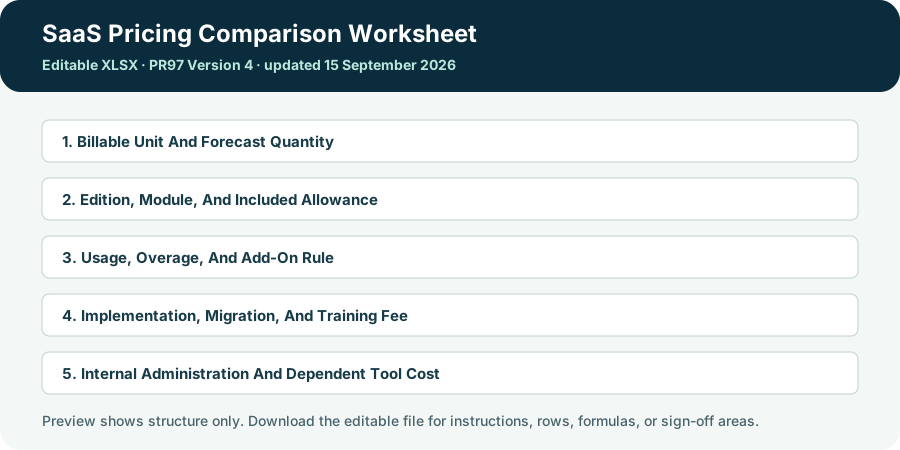
| # | Working area | Completion standard |
|---|---|---|
| 1 | Billable Unit And Forecast Quantity | Record the unit, quantity, rate, period, calculation basis, source, and a conservative alternative assumption. |
| 2 | Edition, Module, And Included Allowance | Record the specific fact, its dated source, accountable owner, current status, and consequence if it remains unresolved. |
| 3 | Usage, Overage, And Add-On Rule | Record the specific fact, its dated source, accountable owner, current status, and consequence if it remains unresolved. |
| 4 | Implementation, Migration, And Training Fee | Record the unit, quantity, rate, period, calculation basis, source, and a conservative alternative assumption. |
| 5 | Internal Administration And Dependent Tool Cost | Record the unit, quantity, rate, period, calculation basis, source, and a conservative alternative assumption. |
| 6 | Renewal, Reduction, Export, And Exit Assumption | Name the objects, volume, format, ownership and permission rules, validation sample, tolerance, retention, and evidence. |
Worked example
A 120-seat buyer receives one quote with implementation bundled and another with a separate $14,000 services line. The worksheet keeps license, usage, implementation, internal labor, renewal, and exit assumptions separate so the lower first-year quote cannot hide a higher three-year cost.
In the SaaS Pricing Comparison Worksheet decision, this evidence rule applies: the example shows the level of specificity expected; replace it with the buyer's own users, volumes, dates, evidence, commercial terms, and acceptance authority. Do not copy an example into an approval record as if it were observed evidence.
Review timing
Update it whenever seat counts, included usage, services scope, renewal uplift, or contract term changes.
Failure modes this template is designed to expose
- Comparing monthly list prices while ignoring annual commitment
- Treating unknown implementation work as zero
- Mixing one-time and recurring costs
- Leaving renewal uplift and reduction rights outside the model
Completion sequence for this file
- Set the boundary: agree Billable Unit And Forecast Quantity and Edition, Module, And Included Allowance before collecting detailed answers.
- Reconcile the record: test Usage, Overage, And Add-On Rule against Implementation, Migration, And Training Fee; preserve the source and explain conflicts.
- Close or escalate: use Internal Administration And Dependent Tool Cost and Renewal, Reduction, Export, And Exit Assumption to record the final action, authority, evidence, and next review.
Field-level Decision comments for this file
For SaaS Pricing Comparison Worksheet, the practical checkpoint is specific: the six working areas below are connected. Reviewers should reconcile them rather than complete each cell in isolation.
Billable Unit And Forecast Quantity
Begin this check with Billable Unit And Forecast Quantity. For the SaaS Pricing Comparison Worksheet, reliable support normally includes a dated quote or invoice, the exact unit and period, a quantity source, and the calculation used. Cross-check the result against Edition, Module, And Included Allowance, because a mismatch can change whether the file supports the decision to normalize unlike SaaS quotes into one three-year cost view before commercial approval. Return the entry to its owner when it relies on a rate without its billing term, an unexplained zero, or a forecast copied from vendor marketing. A reviewer should be able to reproduce the conclusion without attending the original meeting.
Edition, Module, And Included Allowance
The next control point is Edition, Module, And Included Allowance. For the SaaS Pricing Comparison Worksheet, reliable support normally includes a dated primary record, accountable owner, review status, business consequence, and the proof required for closure. Cross-check the result against Usage, Overage, And Add-On Rule, because a mismatch can change whether the file supports the decision to normalize unlike SaaS quotes into one three-year cost view before commercial approval. Return the entry to its owner when it relies on an unlabeled assumption, copied answer, or blank cell that another reviewer might mistake for confirmation. If the source changes, update the entry and state whether the decision changes with it.
Usage, Overage, And Add-On Rule
Treat as decision evidence Usage, Overage, And Add-On Rule. For the SaaS Pricing Comparison Worksheet, reliable support normally includes a dated primary record, accountable owner, review status, business consequence, and the proof required for closure. Cross-check the result against Implementation, Migration, And Training Fee, because a mismatch can change whether the file supports the decision to normalize unlike SaaS quotes into one three-year cost view before commercial approval. Return the entry to its owner when it relies on an unlabeled assumption, copied answer, or blank cell that another reviewer might mistake for confirmation. Where proof is incomplete, preserve a conservative assumption and a dated closure action.
Implementation, Migration, And Training Fee
Before sign-off, challenge Implementation, Migration, And Training Fee. For the SaaS Pricing Comparison Worksheet, reliable support normally includes a dated quote or invoice, the exact unit and period, a quantity source, and the calculation used. Cross-check the result against Internal Administration And Dependent Tool Cost, because a mismatch can change whether the file supports the decision to normalize unlike SaaS quotes into one three-year cost view before commercial approval. Return the entry to its owner when it relies on a rate without its billing term, an unexplained zero, or a forecast copied from vendor marketing. Any accepted limitation needs a named authority, business consequence, and next review date.
Internal Administration And Dependent Tool Cost
Use an independent review of Internal Administration And Dependent Tool Cost. For the SaaS Pricing Comparison Worksheet, reliable support normally includes a dated quote or invoice, the exact unit and period, a quantity source, and the calculation used. Cross-check the result against Renewal, Reduction, Export, And Exit Assumption, because a mismatch can change whether the file supports the decision to normalize unlike SaaS quotes into one three-year cost view before commercial approval. Return the entry to its owner when it relies on a rate without its billing term, an unexplained zero, or a forecast copied from vendor marketing. The completed entry should survive renewal, incident, audit, or replacement review.
Renewal, Reduction, Export, And Exit Assumption
Close the record only after reviewing Renewal, Reduction, Export, And Exit Assumption. For the SaaS Pricing Comparison Worksheet, reliable support normally includes an object inventory, volume, format, owner and permission mapping, sample method, tolerance, retention rule, and reconciliation output. Cross-check the result against Billable Unit And Forecast Quantity, because a mismatch can change whether the file supports the decision to normalize unlike SaaS quotes into one three-year cost view before commercial approval. Return the entry to its owner when it relies on using record count alone while relationships, permissions, attachments, history, or retained copies remain untested. Do not mark this area complete until its contradiction with the connected field is resolved.
Approval questions specific to the SaaS Pricing Comparison Worksheet
- Billable Unit And Forecast Quantity: What would independently confirm this entry, and what happens to the decision if the only available support is a rate without its billing term, an unexplained zero, or a forecast copied from vendor marketing?
- Edition, Module, And Included Allowance: What would independently confirm this entry, and what happens to the decision if the only available support is an unlabeled assumption, copied answer, or blank cell that another reviewer might mistake for confirmation?
- Usage, Overage, And Add-On Rule: What would independently confirm this entry, and what happens to the decision if the only available support is an unlabeled assumption, copied answer, or blank cell that another reviewer might mistake for confirmation?
- Implementation, Migration, And Training Fee: What would independently confirm this entry, and what happens to the decision if the only available support is a rate without its billing term, an unexplained zero, or a forecast copied from vendor marketing?
- Internal Administration And Dependent Tool Cost: What would independently confirm this entry, and what happens to the decision if the only available support is a rate without its billing term, an unexplained zero, or a forecast copied from vendor marketing?
Final challenge: Could procurement, finance, IT, and the business owner comparing two or more vendor quotes explain the decision, reproduce its key calculation or control, and identify the next action from this file alone? If not, the record is not ready for approval.