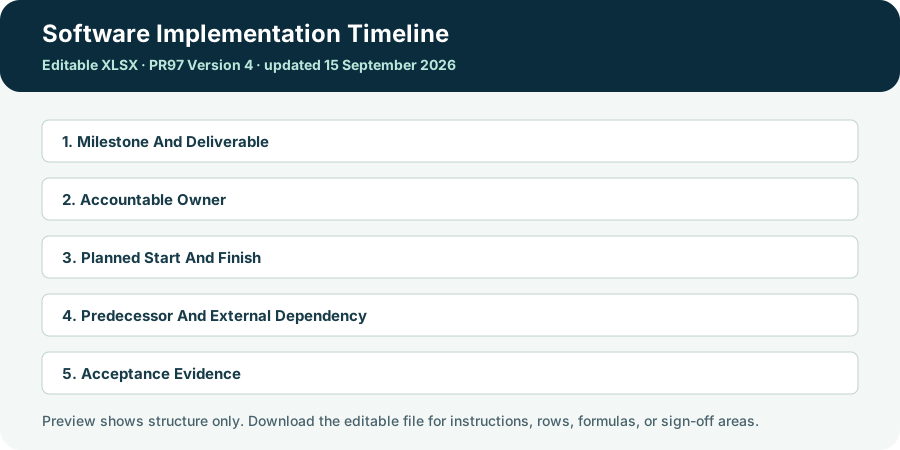
This file helps a buyer expose dependencies, acceptance evidence, and recovery ownership behind a target go-live date. It does not make the decision automatically; named reviewers must attach evidence, resolve mandatory gaps, and sign the final record.
For Software Implementation Timeline, the practical checkpoint is specific: 1 worksheet(s): Working File; working range up to 24 rows by 9 columns; 20 formula cells; 1 data-validation rule(s). File size: 5,426 bytes. Counts describe the packaged file and are not marketing estimates.
What is inside the download
| # | Working area | Completion standard |
|---|---|---|
| 1 | Milestone And Deliverable | Record the specific fact, its dated source, accountable owner, current status, and consequence if it remains unresolved. |
| 2 | Accountable Owner | Name an accountable person or role, define the decision or action they own, and state how completion will be confirmed. |
| 3 | Planned Start And Finish | Use an exact date, source, timezone or notice rule where relevant; assign the person who must act before it. |
| 4 | Predecessor And External Dependency | Record the specific fact, its dated source, accountable owner, current status, and consequence if it remains unresolved. |
| 5 | Acceptance Evidence | Link or identify the dated artifact, scope, owner, reviewer, and any gap that prevents it from supporting the decision. |
| 6 | Status, Variance, And Recovery Action | Use a defined scale or status, cite the evidence, record dissent or conditions, and assign the next action and date. |
Worked example
Single sign-on cannot be tested until identity groups are approved, while migrated-data validation must finish before training examples are frozen. Linking those predecessors shows why a two-week vendor configuration delay threatens go-live and which recovery action is credible.
In the Software Implementation Timeline decision, this evidence rule applies: the example shows the level of specificity expected; replace it with the buyer's own users, volumes, dates, evidence, commercial terms, and acceptance authority. Do not copy an example into an approval record as if it were observed evidence.
Review timing
Baseline it after scope approval and update actual dates, dependencies, acceptance, and recovery actions at every project review.
Failure modes this template is designed to expose
- Listing activities without deliverables
- Assigning teams instead of accountable people
- Showing finish dates without acceptance evidence
- Moving go-live without updating dependent controls and communications
Completion sequence for this file
- Set the boundary: agree Milestone And Deliverable and Accountable Owner before collecting detailed answers.
- Reconcile the record: test Planned Start And Finish against Predecessor And External Dependency; preserve the source and explain conflicts.
- Close or escalate: use Acceptance Evidence and Status, Variance, And Recovery Action to record the final action, authority, evidence, and next review.
Field-level Decision comments for this file
For Software Implementation Timeline, the practical checkpoint is specific: the six working areas below are connected. Reviewers should reconcile them rather than complete each cell in isolation.
Milestone And Deliverable
Begin this check with Milestone And Deliverable. For the Software Implementation Timeline, reliable support normally includes a dated primary record, accountable owner, review status, business consequence, and the proof required for closure. Cross-check the result against Accountable Owner, because a mismatch can change whether the file supports the decision to expose dependencies, acceptance evidence, and recovery ownership behind a target go-live date. Return the entry to its owner when it relies on an unlabeled assumption, copied answer, or blank cell that another reviewer might mistake for confirmation. A reviewer should be able to reproduce the conclusion without attending the original meeting.
Accountable Owner
The next control point is Accountable Owner. For the Software Implementation Timeline, reliable support normally includes a named accountable role, its authority, the population in scope, and the record that confirms action. Cross-check the result against Planned Start And Finish, because a mismatch can change whether the file supports the decision to expose dependencies, acceptance evidence, and recovery ownership behind a target go-live date. Return the entry to its owner when it relies on assigning a department instead of a person or omitting guests, contractors, privileged users, and shared accounts. If the source changes, update the entry and state whether the decision changes with it.
Planned Start And Finish
Treat as decision evidence Planned Start And Finish. For the Software Implementation Timeline, reliable support normally includes the governing contract, approved project plan, timezone, notice method, and accountable calendar owner. Cross-check the result against Predecessor And External Dependency, because a mismatch can change whether the file supports the decision to expose dependencies, acceptance evidence, and recovery ownership behind a target go-live date. Return the entry to its owner when it relies on confusing a term-end date with the last safe action date or treating an aspirational milestone as committed. Where proof is incomplete, preserve a conservative assumption and a dated closure action.
Predecessor And External Dependency
Before sign-off, challenge Predecessor And External Dependency. For the Software Implementation Timeline, reliable support normally includes a dated primary record, accountable owner, review status, business consequence, and the proof required for closure. Cross-check the result against Acceptance Evidence, because a mismatch can change whether the file supports the decision to expose dependencies, acceptance evidence, and recovery ownership behind a target go-live date. Return the entry to its owner when it relies on an unlabeled assumption, copied answer, or blank cell that another reviewer might mistake for confirmation. Any accepted limitation needs a named authority, business consequence, and next review date.
Acceptance Evidence
Use an independent review of Acceptance Evidence. For the Software Implementation Timeline, reliable support normally includes the actual dated artifact, its scope and period, the reviewer, and a link in an approved evidence repository. Cross-check the result against Status, Variance, And Recovery Action, because a mismatch can change whether the file supports the decision to expose dependencies, acceptance evidence, and recovery ownership behind a target go-live date. Return the entry to its owner when it relies on recording a document title without checking boundaries, exceptions, expiry, or whether it covers the purchased service. The completed entry should survive renewal, incident, audit, or replacement review.
Status, Variance, And Recovery Action
Close the record only after reviewing Status, Variance, And Recovery Action. For the Software Implementation Timeline, reliable support normally includes a specific event, likelihood, business consequence, trigger, mitigation, decision authority, and closure proof. Cross-check the result against Milestone And Deliverable, because a mismatch can change whether the file supports the decision to expose dependencies, acceptance evidence, and recovery ownership behind a target go-live date. Return the entry to its owner when it relies on using a vague red-amber-green label that has no trigger, owner, due date, or consequence. Do not mark this area complete until its contradiction with the connected field is resolved.
Approval questions specific to the Software Implementation Timeline
- Milestone And Deliverable: What would independently confirm this entry, and what happens to the decision if the only available support is an unlabeled assumption, copied answer, or blank cell that another reviewer might mistake for confirmation?
- Accountable Owner: What would independently confirm this entry, and what happens to the decision if the only available support is assigning a department instead of a person or omitting guests, contractors, privileged users, and shared accounts?
- Planned Start And Finish: What would independently confirm this entry, and what happens to the decision if the only available support is confusing a term-end date with the last safe action date or treating an aspirational milestone as committed?
- Predecessor And External Dependency: What would independently confirm this entry, and what happens to the decision if the only available support is an unlabeled assumption, copied answer, or blank cell that another reviewer might mistake for confirmation?
- Acceptance Evidence: What would independently confirm this entry, and what happens to the decision if the only available support is recording a document title without checking boundaries, exceptions, expiry, or whether it covers the purchased service?
Final challenge: Could implementation leads, vendor project managers, IT, business owners, data teams, and procurement explain the decision, reproduce its key calculation or control, and identify the next action from this file alone? If not, the record is not ready for approval.