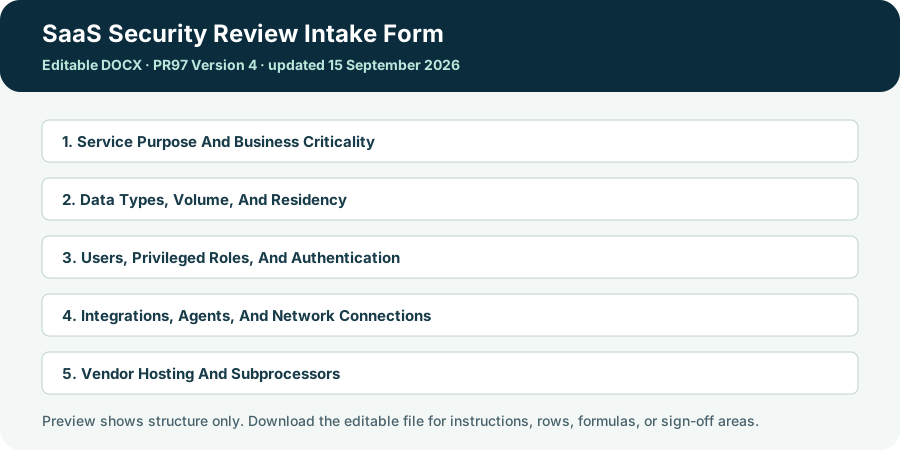
This file helps a buyer give security reviewers enough service, data, identity, integration, and timeline context to scope a review. It does not make the decision automatically; named reviewers must attach evidence, resolve mandatory gaps, and sign the final record.
Editable Word document containing 75 paragraph elements and 3 table(s) in the document structure. File size: 40,026 bytes. Counts describe the packaged file and are not marketing estimates.
What is inside the download
| # | Working area | Completion standard |
|---|---|---|
| 1 | Service Purpose And Business Criticality | Write an observable business result with actor, context, exception, volume, output, and pass threshold. |
| 2 | Data Types, Volume, And Residency | Record the unit, quantity, rate, period, calculation basis, source, and a conservative alternative assumption. |
| 3 | Users, Privileged Roles, And Authentication | Name an accountable person or role, define the decision or action they own, and state how completion will be confirmed. |
| 4 | Integrations, Agents, And Network Connections | Define the scope, required control behavior, responsible party, configuration or contract proof, and unresolved exposure. |
| 5 | Vendor Hosting And Subprocessors | Define the scope, required control behavior, responsible party, configuration or contract proof, and unresolved exposure. |
| 6 | Availability Need, Incident Route, And Requested Launch Date | Use an exact date, source, timezone or notice rule where relevant; assign the person who must act before it. |
Worked example
A low-cost browser tool becomes a high-priority review because it processes employee health information, uses a privileged directory integration, and must launch in three weeks. The intake form exposes those facts before a generic questionnaire is sent.
For this SaaS Security Review Intake Form review, use this evidence rule: the example shows the level of specificity expected; replace it with the buyer's own users, volumes, dates, evidence, commercial terms, and acceptance authority. Do not copy an example into an approval record as if it were observed evidence.
Review timing
Submit it before purchase or trial configuration and revise it when data, integrations, regions, or privileged roles change.
Failure modes this template is designed to expose
- Describing only the product name
- Writing 'no sensitive data' without data categories
- Omitting agents and integrations
- Promising a launch date before review scope is known
Completion sequence for this file
- Set the boundary: agree Service Purpose And Business Criticality and Data Types, Volume, And Residency before collecting detailed answers.
- Reconcile the record: test Users, Privileged Roles, And Authentication against Integrations, Agents, And Network Connections; preserve the source and explain conflicts.
- Close or escalate: use Vendor Hosting And Subprocessors and Availability Need, Incident Route, And Requested Launch Date to record the final action, authority, evidence, and next review.
Field-level Decision comments for this file
For SaaS Security Review Intake Form, this requirement applies: the six working areas below are connected. Reviewers should reconcile them rather than complete each cell in isolation.
Service Purpose And Business Criticality
Begin this check with Service Purpose And Business Criticality. For the SaaS Security Review Intake Form, reliable support normally includes an actor, realistic starting data, action, exception, volume, output, and observable pass threshold. Cross-check the result against Data Types, Volume, And Residency, because a mismatch can change whether the file supports the decision to give security reviewers enough service, data, identity, integration, and timeline context to scope a review. Return the entry to its owner when it relies on a feature name or adjective that lets every vendor claim support without completing the buyer's work. A reviewer should be able to reproduce the conclusion without attending the original meeting.
Data Types, Volume, And Residency
The next control point is Data Types, Volume, And Residency. For the SaaS Security Review Intake Form, reliable support normally includes a dated quote or invoice, the exact unit and period, a quantity source, and the calculation used. Cross-check the result against Users, Privileged Roles, And Authentication, because a mismatch can change whether the file supports the decision to give security reviewers enough service, data, identity, integration, and timeline context to scope a review. Return the entry to its owner when it relies on a rate without its billing term, an unexplained zero, or a forecast copied from vendor marketing. If the source changes, update the entry and state whether the decision changes with it.
Users, Privileged Roles, And Authentication
Treat as decision evidence Users, Privileged Roles, And Authentication. For the SaaS Security Review Intake Form, reliable support normally includes a named accountable role, its authority, the population in scope, and the record that confirms action. Cross-check the result against Integrations, Agents, And Network Connections, because a mismatch can change whether the file supports the decision to give security reviewers enough service, data, identity, integration, and timeline context to scope a review. Return the entry to its owner when it relies on assigning a department instead of a person or omitting guests, contractors, privileged users, and shared accounts. Where proof is incomplete, preserve a conservative assumption and a dated closure action.
Integrations, Agents, And Network Connections
Before sign-off, challenge Integrations, Agents, And Network Connections. For the SaaS Security Review Intake Form, reliable support normally includes the intended configuration, service boundary, control owner, test or report, contractual commitment, and accepted residual exposure. Cross-check the result against Vendor Hosting And Subprocessors, because a mismatch can change whether the file supports the decision to give security reviewers enough service, data, identity, integration, and timeline context to scope a review. Return the entry to its owner when it relies on accepting a general security statement that does not cover the plan, integration, data, region, or buyer responsibility. Any accepted limitation needs a named authority, business consequence, and next review date.
Vendor Hosting And Subprocessors
Use an independent review of Vendor Hosting And Subprocessors. For the SaaS Security Review Intake Form, reliable support normally includes the intended configuration, service boundary, control owner, test or report, contractual commitment, and accepted residual exposure. Cross-check the result against Availability Need, Incident Route, And Requested Launch Date, because a mismatch can change whether the file supports the decision to give security reviewers enough service, data, identity, integration, and timeline context to scope a review. Return the entry to its owner when it relies on accepting a general security statement that does not cover the plan, integration, data, region, or buyer responsibility. The completed entry should survive renewal, incident, audit, or replacement review.
Availability Need, Incident Route, And Requested Launch Date
Close the record only after reviewing Availability Need, Incident Route, And Requested Launch Date. For the SaaS Security Review Intake Form, reliable support normally includes the governing contract, approved project plan, timezone, notice method, and accountable calendar owner. Cross-check the result against Service Purpose And Business Criticality, because a mismatch can change whether the file supports the decision to give security reviewers enough service, data, identity, integration, and timeline context to scope a review. Return the entry to its owner when it relies on confusing a term-end date with the last safe action date or treating an aspirational milestone as committed. Do not mark this area complete until its contradiction with the connected field is resolved.
Approval questions specific to the SaaS Security Review Intake Form
- Service Purpose And Business Criticality: What would independently confirm this entry, and what happens to the decision if the only available support is a feature name or adjective that lets every vendor claim support without completing the buyer's work?
- Data Types, Volume, And Residency: What would independently confirm this entry, and what happens to the decision if the only available support is a rate without its billing term, an unexplained zero, or a forecast copied from vendor marketing?
- Users, Privileged Roles, And Authentication: What would independently confirm this entry, and what happens to the decision if the only available support is assigning a department instead of a person or omitting guests, contractors, privileged users, and shared accounts?
- Integrations, Agents, And Network Connections: What would independently confirm this entry, and what happens to the decision if the only available support is accepting a general security statement that does not cover the plan, integration, data, region, or buyer responsibility?
- Vendor Hosting And Subprocessors: What would independently confirm this entry, and what happens to the decision if the only available support is accepting a general security statement that does not cover the plan, integration, data, region, or buyer responsibility?
Final challenge: Could business sponsors, IT owners, security teams, privacy teams, and procurement intake coordinators explain the decision, reproduce its key calculation or control, and identify the next action from this file alone? If not, the record is not ready for approval.